
Contents
- 1 What Is GDPR and Why Should You Care?
- 2 What Counts as Personal Data in Analytics?
- 3 The Cookie Consent Problem
- 4 Three Ways to Handle GDPR Analytics
- 5 What Privacy-First Analytics Can (and Can’t) Track
- 6 Recent GDPR Enforcement: What We’ve Learned
- 7 A Simple GDPR Compliance Checklist
- 8 Beyond GDPR: Other Privacy Regulations
- 9 Common GDPR Myths Debunked
- 10 Making the Switch: Practical Steps
- 11 Bottom Line
If you run a website that gets visitors from Europe, you’ve probably heard about GDPR. Maybe you’ve seen those cookie consent popups everywhere. Perhaps you’ve wondered whether your analytics setup could get you in legal trouble.
Here’s the reality: GDPR compliance doesn’t have to be complicated. Most of the confusion comes from legal jargon and fear-based marketing from compliance tool vendors. For small website owners using basic analytics, the rules are actually straightforward.
This guide explains what GDPR actually requires for website analytics — in plain language. No legal degree needed.
What Is GDPR and Why Should You Care?
GDPR stands for General Data Protection Regulation. It’s a European Union law that went into effect in May 2018. The regulation gives EU residents control over their personal data and sets rules for how businesses can collect and use that data.
Why should you care if you’re not based in Europe? Because GDPR applies to any website that:
- Is based in the EU
- Offers goods or services to EU residents
- Monitors the behavior of EU residents
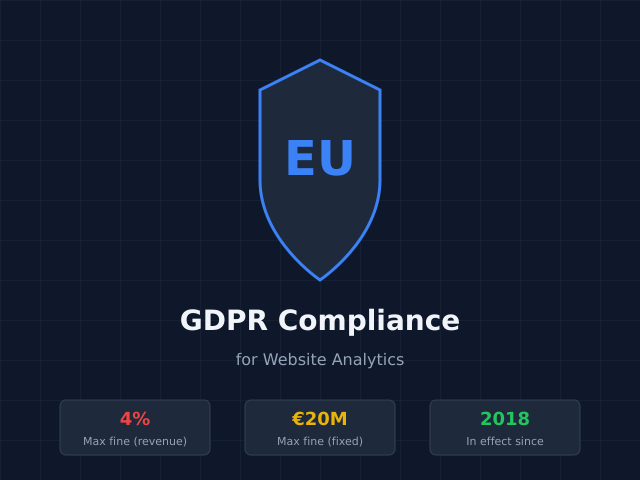
That last point is the key one for analytics. If you track visitors from Europe — even passively through analytics tools — GDPR applies to you. And with fines reaching up to 4% of annual revenue or €20 million (whichever is higher), it’s worth taking seriously.
The good news? Most small websites can achieve compliance with simple changes. You don’t need expensive lawyers or complex consent management platforms.
What Counts as Personal Data in Analytics?
Under GDPR, personal data is any information that can identify a person — directly or indirectly. For website analytics, this includes:
| Data Type | Personal Data? | Why |
|---|---|---|
| IP addresses | Yes | Can identify a household or individual |
| Cookies with unique IDs | Yes | Track individual users across sessions |
| Device fingerprints | Yes | Uniquely identify devices/users |
| User IDs | Yes | Directly identify individuals |
| Email addresses | Yes | Directly identify individuals |
| Aggregate page views | No | Cannot identify individuals |
| Country-level location | No | Too broad to identify anyone |
This is where traditional analytics tools like Google Analytics run into problems. GA4 collects IP addresses, sets cookies, and creates user identifiers by default. All of that requires explicit consent under GDPR.
The Cookie Consent Problem
You’ve seen cookie consent banners everywhere. They exist because GDPR (along with the ePrivacy Directive) requires websites to get consent before storing cookies or similar technologies on a user’s device.
Here’s what proper consent looks like under GDPR:
- Freely given: Users must have a real choice. No “consent walls” that block content.
- Specific: Consent for analytics must be separate from consent for marketing.
- Informed: Users must understand what they’re agreeing to.
- Unambiguous: Pre-ticked boxes don’t count. Users must take action.
- Withdrawable: Users must be able to revoke consent as easily as they gave it.
Most cookie banners fail at least one of these requirements. Those “Accept All” buttons with tiny “Manage Preferences” links? Legally questionable. Dark patterns that make rejecting cookies difficult? Definitely non-compliant.
The Real Impact on Your Analytics
When you implement proper consent for Google Analytics, something frustrating happens: your data becomes unreliable. Studies show that 30-50% of visitors decline tracking when given a genuine choice. In privacy-conscious countries like Germany, rejection rates can exceed 70%.
This creates a paradox. You implement analytics to understand your visitors, but compliance means you only see data from the minority who consent. Your traffic numbers drop, conversion rates become meaningless, and you’re essentially flying blind.
Three Ways to Handle GDPR Analytics
Website owners generally have three options for GDPR-compliant analytics:
Option 1: Consent-Based Tracking (Traditional Approach)
Keep using Google Analytics or similar tools, but implement proper consent management. This means:
- Installing a Consent Management Platform (CMP)
- Blocking all tracking scripts until consent is given
- Accepting that you’ll lose 30-70% of your data
- Maintaining records of consent for compliance audits
Pros: Keep familiar tools, detailed user-level data when consent is given.
Cons: Incomplete data, annoying popups, ongoing compliance burden, potential legal risk if implementation is wrong.
Option 2: Privacy-First Analytics (Recommended)
Switch to analytics tools designed for privacy compliance. These tools work without cookies and don’t collect personal data, eliminating the need for consent banners.
Popular options include:
- Plausible Analytics: Lightweight, cookie-free, EU-hosted
- Fathom Analytics: Privacy-focused with EU data isolation
- Umami: Open-source, self-hosted option
- Simple Analytics: Minimal tracking, GDPR compliant by design
Pros: No consent required, see 100% of traffic, simpler compliance, better user experience.
Cons: Less detailed data, no user-level tracking, may require changing workflows. As I discussed in my guide on analytics for small business, this limitation is actually a feature — it forces you to focus on metrics that matter.
Option 3: Server-Side Analytics
Collect basic analytics data through server logs without any client-side tracking. This is the most privacy-friendly approach but provides limited insights.
Pros: Maximum privacy, no JavaScript required, works with ad blockers.
Cons: Very basic data, requires technical setup, no engagement metrics.
What Privacy-First Analytics Can (and Can’t) Track
A common misconception is that GDPR-compliant analytics means no useful data. That’s not true. Privacy-first tools can still track everything most small businesses need:
| Metric | Privacy-First Tools | Consent Required? |
|---|---|---|
| Page views | Yes | No |
| Unique visitors (daily) | Yes | No |
| Traffic sources | Yes | No |
| Country/region | Yes | No |
| Device type | Yes | No |
| Top pages | Yes | No |
| Bounce rate | Yes | No |
| Goal completions | Yes | No |
| User journeys | Limited | – |
| Individual user tracking | No | Would require consent |
| Cross-device tracking | No | Would require consent |
For most websites, the metrics in the “Yes” column are all you need. As I explained in my article about overcomplicating analytics, tracking individual users often creates more noise than insight.
Recent GDPR Enforcement: What We’ve Learned
Since 2018, European regulators have issued thousands of GDPR fines. Several cases directly affect how websites handle analytics:
Google Analytics Rulings (2022)
Austrian, French, and Italian data protection authorities ruled that using Google Analytics violates GDPR. The main issue? Data transfers to the United States, where privacy protections are weaker than EU law requires.
While Google has since made changes (including EU-based data storage options), these rulings created significant uncertainty. Many European businesses switched to EU-hosted alternatives to avoid risk.
Cookie Banner Enforcement
Regulators have increasingly targeted non-compliant cookie banners. Common violations include:
- Making “Reject All” harder to find than “Accept All”
- Using dark patterns to encourage consent
- Pre-selecting non-essential cookies
- Not providing granular consent options
Fines have ranged from warnings to millions of euros for major companies. The trend is clear: regulators expect genuine choice, not manipulated consent.
A Simple GDPR Compliance Checklist
Here’s a practical checklist for small website owners:
If Using Privacy-First Analytics (Recommended)
- Choose a tool that doesn’t use cookies or collect IP addresses
- Verify data is processed in the EU (or your jurisdiction)
- Update your privacy policy to describe what you track
- Remove cookie consent banners for analytics (you don’t need them)
- Keep consent mechanisms for any other tools that require them
If Using Google Analytics or Similar
- Implement a compliant Consent Management Platform
- Block all tracking until explicit consent is given
- Offer genuine “Reject All” option, equally prominent as “Accept”
- Enable IP anonymization
- Disable data sharing with Google
- Set appropriate data retention periods
- Sign Google’s Data Processing Agreement
- Document your legal basis for processing
- Prepare for significant data loss from declined consent
Notice how much simpler the first list is. That’s not a coincidence — privacy-first tools are designed to make compliance easy.
Beyond GDPR: Other Privacy Regulations
GDPR isn’t the only privacy law you might need to consider:
| Regulation | Region | Key Requirement |
|---|---|---|
| GDPR | European Union | Consent for personal data processing |
| UK GDPR | United Kingdom | Similar to EU GDPR (post-Brexit) |
| CCPA/CPRA | California, USA | Opt-out rights, disclosure requirements |
| LGPD | Brazil | Similar to GDPR |
| POPIA | South Africa | Consent and purpose limitation |
| PIPEDA | Canada | Consent for collection, use, disclosure |
The global trend is clear: privacy regulations are expanding. Tools that comply with GDPR typically meet other regulations too, making them a future-proof choice.
Common GDPR Myths Debunked
Myth: GDPR only applies to EU-based businesses.
Reality: It applies to any business processing EU residents’ data, regardless of location.
Myth: Small websites don’t need to worry about GDPR.
Reality: The law applies regardless of business size. However, enforcement typically focuses on larger violators.
Myth: Cookie banners make you GDPR compliant.
Reality: Only if implemented correctly. Many banners are non-compliant and create false security.
Myth: Anonymizing IP addresses makes Google Analytics compliant.
Reality: It helps, but GA still uses cookies and other identifiers that require consent.
Myth: You need expensive legal help to comply.
Reality: For basic analytics, switching to privacy-first tools is simpler and cheaper than legal consultation.
Making the Switch: Practical Steps
If you’ve decided to switch to privacy-first analytics, here’s a simple migration path:
- Choose your tool. Plausible and Fathom are the most popular paid options. Umami is excellent if you can self-host.
- Run both tools in parallel for 2-4 weeks to compare data.
- Update your privacy policy to reflect the new tracking approach.
- Remove the old tracking code and any associated consent banners.
- Verify the new setup is working correctly.
Most privacy-first tools can be installed in under 5 minutes. The hardest part is usually letting go of data you never really needed.
Bottom Line
GDPR compliance for website analytics comes down to a simple choice: either get proper consent for tracking (and accept significant data loss), or use tools that don’t require consent in the first place.
For most small websites, privacy-first analytics is the obvious answer. You get cleaner data, better user experience, simpler compliance, and protection against evolving regulations. The only thing you lose is the ability to track individual users — something that rarely provides actionable insights anyway.
The era of tracking everything about everyone is ending. Websites that adapt now will be better positioned than those scrambling to comply later.