Privacy first analytics flips the usual logic of website measurement. Instead of collecting as much data as possible and figuring out compliance later, it starts with privacy and works backward to the metrics you actually need. The result is a simpler, safer way to understand your traffic — and it’s becoming the default choice for thoughtful website owners.
I’ve watched this shift happen over the past few years. Tools that once felt niche are now mainstream, and the reasons go beyond regulation. In this guide, I’ll explain what privacy first analytics really means, why it matters for your website, and how to tell whether a tool genuinely delivers on the promise.
What Does Privacy First Analytics Mean?
Privacy first analytics is an approach where protecting visitor data is the starting point, not an afterthought. These tools are built so that personal information either isn’t collected at all or is anonymized before it’s ever stored. Consequently, the data you see reflects behavior patterns rather than identifiable individuals.
Contrast that with the traditional model. Conventional analytics platforms collect detailed personal data by default, then ask you to bolt on consent banners and privacy settings afterward. Privacy first analytics reverses the order — privacy comes baked in, and you opt into more data collection only if you truly need it.
In short: Privacy first analytics asks “what’s the least data we need to answer this question?” rather than “how much can we collect?”
The Core Principles
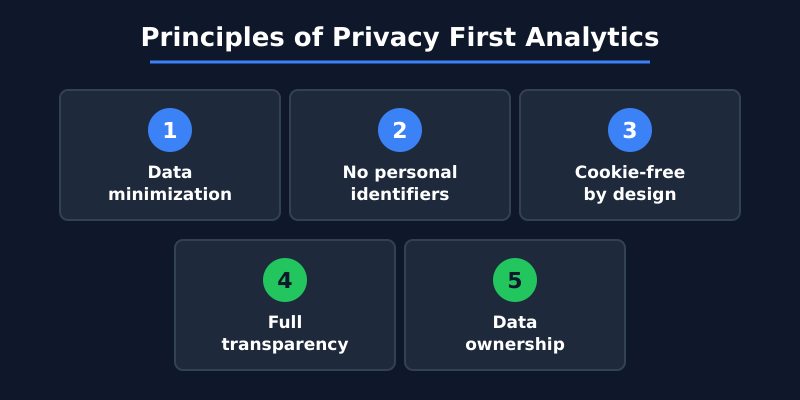
Not every tool that claims to be privacy-friendly actually is. To separate genuine privacy first analytics from marketing spin, look for these principles:
Data minimization — Only essential, aggregate metrics get collected
No personal identifiers — No names, emails, or persistent device IDs
Cookie-free by design — No tracking cookies, so no consent banner needed
Transparency — Clear, public documentation of exactly what’s collected
Data ownership — Your data stays yours and isn’t resold or repurposed
When a tool follows these principles, it aligns naturally with regulations like GDPR. As a result, compliance becomes a built-in feature rather than an ongoing chore. That’s the practical payoff of privacy first analytics.
Why Privacy First Analytics Matters
The benefits go well beyond ticking a legal box. In my experience, switching to a privacy first approach pays off in several concrete ways:
Benefit
Why it matters
Simpler compliance
No personal data means far less legal exposure
More complete data
No consent banner, so you measure every visitor
Faster websites
Lightweight scripts load quickly and improve UX
Visitor trust
Respecting privacy strengthens your brand reputation
Less complexity
Clean dashboards instead of overwhelming reports
That second point deserves emphasis. When you require consent, your data only includes visitors who opted in — often a minority. With privacy first analytics, your reports reflect everyone. Therefore, the numbers you base decisions on are more trustworthy.
How It Differs From Traditional Analytics
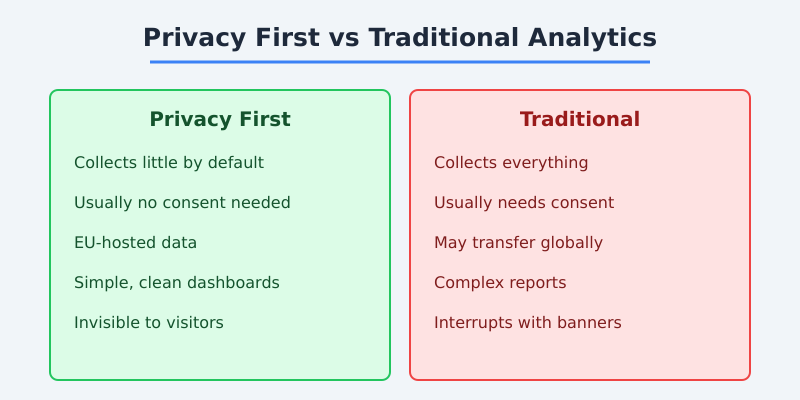
The contrast with tools like Google Analytics is stark. Here’s how the two philosophies diverge in practice:
Default behavior — Privacy first collects little; traditional collects everything
Consent requirement — Privacy first often needs none; traditional usually does
Data location — Privacy first favors EU hosting; traditional may transfer globally
Complexity — Privacy first keeps it simple; traditional offers depth you may not use
Visitor experience — Privacy first stays invisible; traditional interrupts with banners
For a deeper look at where Google Analytics struggles with these issues, my guide on GDPR and website analytics covers the legal mechanics in plain English.
Who Benefits Most From Privacy First Analytics?
While almost any site can benefit, some owners gain more than others. Privacy first analytics is an especially strong fit for:
Small businesses — Who want answers without compliance overhead
Bloggers and creators — Who need simple metrics, not enterprise dashboards
Privacy-conscious brands — Where respecting users is part of the value proposition
EU-facing websites — Where GDPR enforcement is a real concern
If you fall into any of these groups, the switch is usually low-effort and high-reward. You’re unlikely to miss the features you leave behind. As I explain in my breakdown of analytics overcomplication, most of those advanced features were never moving the needle anyway.
Is There a Catch?
To be honest, privacy first analytics does involve trade-offs. You won’t get the granular, individual-level tracking that powers advanced advertising attribution. Likewise, very large enterprises with complex needs may find the simpler tools limiting.
For the vast majority of websites, though, those limits are irrelevant. The metrics that drive real decisions — traffic volume, sources, popular content, conversion trends — are all available. In other words, you lose detail you weren’t using and keep everything you actually need. The European Data Protection Supervisor offers useful background on why this minimalist approach holds up legally, and Article 5 of the GDPR codifies data minimization as a core legal principle.
Getting Started With Privacy First Analytics
Making the switch is more straightforward than you might expect. Here’s the basic path:
Pick a privacy first tool — Look for cookie-free, EU-hosted options
Install the lightweight script — Usually a single line in your header
Remove old tracking code — Clear out heavier, cookie-based scripts
Revisit your consent banner — You may be able to remove it entirely
Focus on the metrics that matter — Use the clean dashboard to make decisions
Within an afternoon, you can have a faster, simpler, more compliant setup running. That’s the quiet power of privacy first analytics — it removes problems rather than adding features.
Common Myths Worth Clearing Up
A few misconceptions keep owners from making the switch. Let me address the ones I hear most often:
“Privacy first means less accurate.” The opposite is usually true. Because you skip consent banners, you measure every visitor, not just the ones who opt in.
“It can’t handle conversions.” Most tools track goals and events just fine — they simply do it without profiling individuals.
“Switching is risky.” You can run both tools in parallel for a week to compare numbers before fully migrating.
Once these myths fall away, the decision gets a lot easier. In practice, the transition is low-stakes and reversible, so there’s little reason to hesitate.
Bottom Line
Privacy first analytics isn’t a compromise. It’s a smarter default for how websites measure their traffic. By starting with privacy and collecting only what’s necessary, these tools deliver cleaner data, faster sites, and built-in compliance — all while respecting the people who visit you.
For most small business owners, bloggers, and privacy-conscious brands, the case is clear. You give up data you weren’t using and gain simplicity, trust, and peace of mind. In my experience, that’s a trade worth making every time.
Eleanor Weiss
Privacy-first analytics
Eleanor Weiss is a certified digital marketer (Google Analytics IQ, HubSpot Inbound) with 10+ years of experience in website analytics. After spending weeks trying to figure out GA4, she asked herself: why? Most websites don't need complex funnels and machine learning. They need simple answers. That's why she started PrivacyAnalytics.io — honest reviews of privacy-friendly analytics tools that just work.




 Eleanor Weiss
·
12 min read
Eleanor Weiss
·
12 min read