Finding GDPR compliant analytics doesn’t have to mean drowning in cookie banners or legal disclaimers. A growing class of privacy-first tools collects useful website data without tracking individuals, which sidesteps most of the consent headaches that come with Google Analytics. In this guide, I’ll walk through what makes an analytics tool GDPR compliant and which alternatives genuinely deliver.
I’ve tested a fair number of these platforms over the years, often switching clients away from heavyweight tools they never needed. The good news is that GDPR compliant analytics has matured a lot. You no longer have to choose between respecting privacy and understanding your traffic.
What Makes Analytics GDPR Compliant?
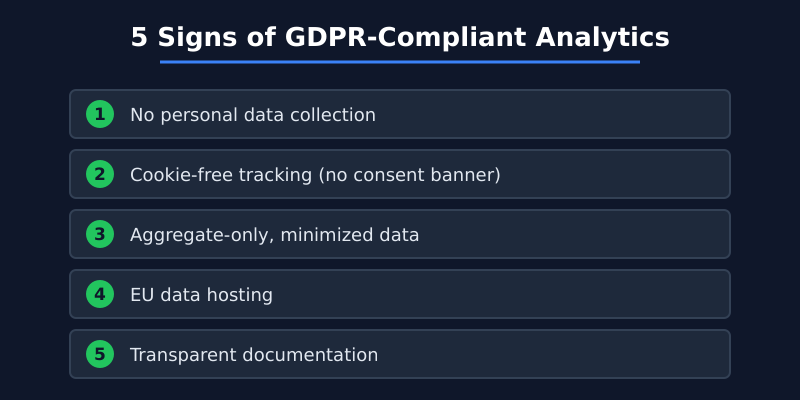
Before comparing tools, it helps to know what you’re actually looking for. An analytics platform earns the “GDPR compliant” label when it handles data in a way that satisfies the regulation’s core principles. Specifically, that means:
No personal data collection — Or at least no data that identifies individuals
Cookie-free tracking — Which removes the legal trigger for consent banners
Data minimization — Collecting only aggregate, non-identifying metrics
EU data hosting — Keeping data within Europe avoids transfer complications
Transparency — Clear documentation of what’s collected and how
When a tool ticks these boxes, the consent requirement under GDPR often disappears. As a result, you can track visitors without interrupting their experience. That’s the whole appeal of GDPR compliant analytics.
Quick Comparison of Privacy-First Tools
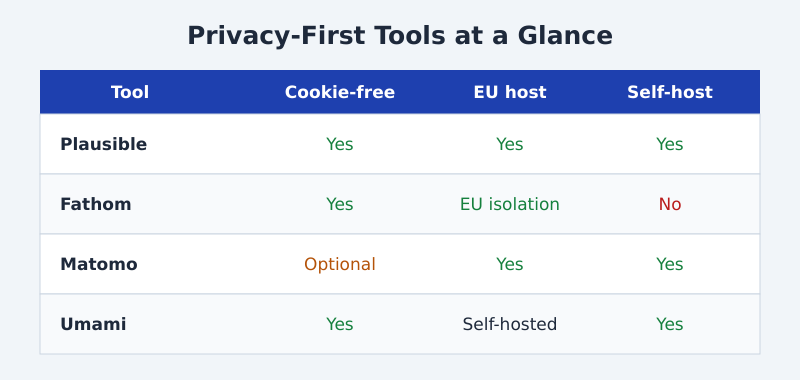
To give you a fast overview, here’s how the leading privacy-focused platforms generally stack up. I’ve kept this to the criteria that matter most for compliance:
Tool
Cookie-free
EU hosting
Open source
Self-hosting option
Plausible
Yes
Yes
Yes
Yes
Fathom
Yes
Yes (EU isolation)
No
No
Matomo
Optional
Yes
Yes
Yes
Umami
Yes
Self-hosted
Yes
Yes
Each of these takes a slightly different approach. However, they all share the same goal: useful insights without compromising visitor privacy. Below, I’ll break down what makes each one worth considering.
Plausible: Lightweight and Cookie-Free
Plausible is one of the cleanest privacy-first tools I’ve used. It’s cookie-free by design, hosts data in the EU, and the entire dashboard fits on a single page. Consequently, there’s no learning curve — you see your numbers and move on.
The script is tiny, which keeps your site fast. Moreover, because it doesn’t collect personal data, you generally don’t need a consent banner. For small business owners who want answers without complexity, it’s an easy recommendation. You can review the technical details in the Plausible data policy.
Fathom: Simple Reports, Strong Privacy
Fathom Analytics takes a similar philosophy. It’s cookie-free, anonymizes data, and offers EU data isolation for European visitors. The interface is friendly, and setup takes a couple of minutes.
In my testing, Fathom felt especially well suited to non-technical owners. It surfaces the essentials — visitors, page views, referrers — without burying them under options. That said, it’s a paid-only tool, so there’s no free tier to experiment with.
Matomo: The Feature-Rich Option
Matomo is the closest thing to a full Google Analytics replacement. It offers funnels, heatmaps, goal tracking, and detailed segmentation. Importantly, you can self-host it, which gives you complete control over your data.
The trade-off is complexity. Matomo can be configured to run cookie-free and consent-free, but you’ll need to adjust settings to get there. For owners who genuinely need advanced features and don’t mind the setup, though, it’s a powerful choice. The Matomo GDPR documentation explains the privacy configuration in detail.
Umami: Open Source and Self-Hosted
Umami appeals to the technically inclined. It’s open source, free to self-host, and collects only anonymous, aggregate data. Because you run it on your own infrastructure, your visitor data never leaves your control.
Naturally, self-hosting requires some technical comfort. You’ll need a server and a database. For developers or agencies, however, Umami offers privacy and ownership at essentially zero ongoing cost.
How to Choose the Right Tool
With several solid options, the decision comes down to your priorities. Here’s how I’d think it through:
Want the simplest setup? Plausible or Fathom
Need advanced features like funnels? Matomo
Comfortable self-hosting for full control? Umami or self-hosted Matomo
On a strict budget? Umami (free, self-hosted) or self-hosted Matomo
Before you switch, it’s worth clarifying what you actually need to measure. My guide to small business analytics can help you avoid paying for features you’ll never touch. Most sites need far less than they think.
Tip: “GDPR compliant” depends on configuration as much as the tool. Even a privacy-first platform needs an accurate privacy policy and honest disclosure of what you collect.
A Word on Compliance Responsibility
No analytics tool makes you compliant on its own. The vendor handles the technical side, but you’re still responsible for your privacy policy, your disclosures, and how you use the data. Therefore, treat these tools as a strong foundation rather than a complete solution.
If you also collect data through forms, email, or other channels, those need attention too. For the broader picture on regulations, my comparison of CCPA and GDPR covers what applies where.
Bottom Line
GDPR compliant analytics is no longer a contradiction. Tools like Plausible, Fathom, Matomo, and Umami prove you can understand your traffic without tracking individuals or burying visitors under consent prompts. Each suits a different need, from one-click simplicity to full self-hosted control.
For most small business owners, switching to GDPR compliant analytics means cleaner data, fewer legal worries, and a faster website. In my experience, once you make the move, you rarely look back at the banner-heavy world you left behind.
Eleanor Weiss
Privacy-first analytics
Eleanor Weiss is a certified digital marketer (Google Analytics IQ, HubSpot Inbound) with 10+ years of experience in website analytics. After spending weeks trying to figure out GA4, she asked herself: why? Most websites don't need complex funnels and machine learning. They need simple answers. That's why she started PrivacyAnalytics.io — honest reviews of privacy-friendly analytics tools that just work.




 Eleanor Weiss
·
9 min read
Eleanor Weiss
·
9 min read